
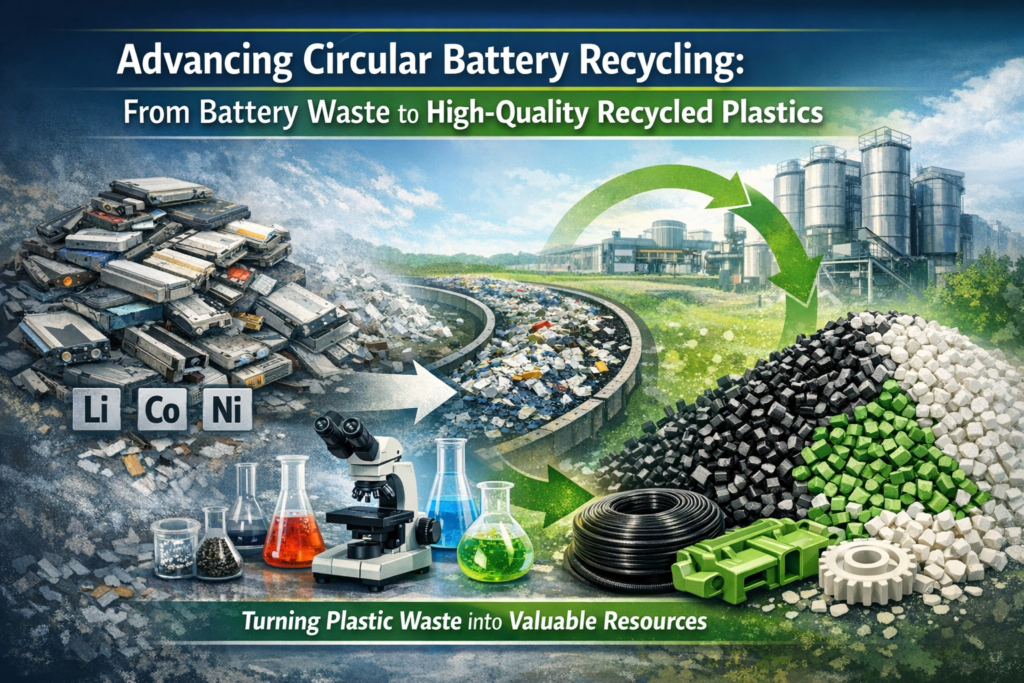
When discussing battery recycling, the focus often lies on critical metals such as lithium, cobalt, or nickel. While their recovery is essential, a truly circular battery value chain must go further. Large shares of end-of-life lithium-ion batteries consist of plastics and polymer-based components – materials that are frequently overlooked, downcycled, or discarded altogether.
Within the Horizon Europe project BeyondBattRec, Andaltec is addressing this challenge by turning plastic waste from battery recycling into high-quality recycled materials suitable for new industrial applications.
Why plastics matter in battery recycling
Lithium-ion batteries contain a wide range of polymeric materials, including housings, separators, foils, insulation components, and cable coatings. These plastics play a key role in battery safety and performance during use, but at end of life they present significant recycling challenges. Mixed material streams, contamination, ageing effects, and strict quality requirements make it difficult to reintegrate them into value chains.
As a result, even advanced recycling concepts often prioritise metals, while plastics remain an untapped resource. BeyondBattRec takes a different approach: the project aims to valorise all battery components, including non-metallic fractions, as a prerequisite for achieving high recycling rates and real circularity.
Andaltec’s contribution: turning plastic waste into valuable materials
As a technology centre specialised in plastics, materials development, and recycling, Andaltec contributes its expertise precisely at this critical interface. Within BeyondBattRec, Andaltec is responsible for the valorisation of plastic and polymeric components recovered during battery dismantling and pre-processing.
The goal is not only to recycle plastics, but to ensure that the resulting materials meet the technical and functional requirements of industrial users. This involves:
- Analysing the composition and quality of polymer fractions from battery waste
- Addressing contamination and degradation issues
- Optimising recycling and compounding processes
- Developing recycled plastic pellets with defined and reproducible properties
By focusing on material quality from the outset, Andaltec helps bridge the gap between recycling processes and real-world industrial applications.
From laboratory scale to industrial relevance
One of the main challenges in plastic recycling is the step from laboratory feasibility to industrial usability. Materials must not only be recyclable, but also processable, reliable, and compatible with existing manufacturing routes.
Within BeyondBattRec, Andaltec therefore works at both laboratory and pilot scale, combining material characterisation with process optimisation. This approach ensures that recycled plastics are not only technically viable, but also scalable and economically relevant – a crucial factor for their future uptake by industry.
Strengthening circularity beyond metals
By enabling high-quality recycling of polymer components, Andaltec’s work contributes directly to the overarching goals of BeyondBattRec: increasing overall recycling rates, reducing waste, and strengthening the sustainability of the European battery value chain.
Recovering plastics alongside metals allows more battery material to remain in circulation, reduces the need for virgin resources, and supports Europe’s transition towards a fully circular economy.
In BeyondBattRec, Andaltec demonstrates that plastics are not a side stream of battery recycling, but a key element of it– and that closing the loop requires solutions that consider every material in the battery, from metals to polymers.
Picture credits: Produced by acib with Copilot