
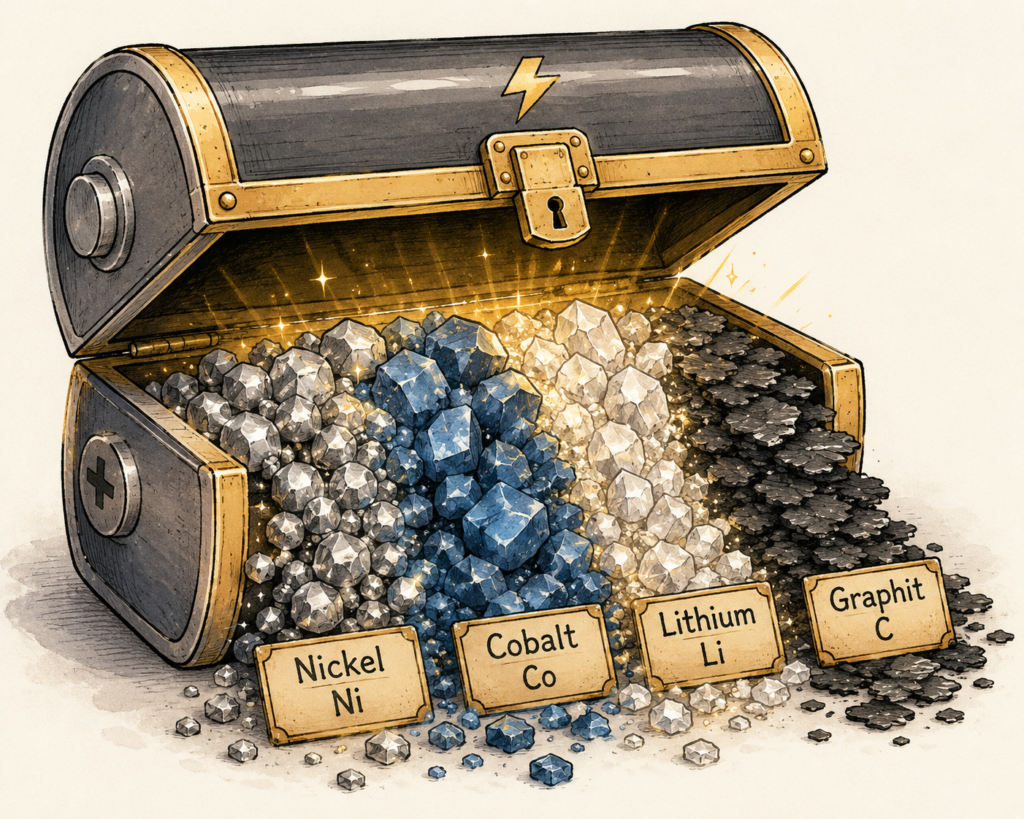
At the heart of lithium‑ion battery recycling lies a deceptively simple but technically complex material: black mass. This fine powder, produced when end‑of‑life batteries are mechanically recycled , contains most of the critical and strategical raw materials that Europe needs for its energy transition – graphite, lithium, nickel, cobalt and manganese. Turning black mass back into high‑value products is a key challenge for the circular battery economy.
Within the BeyondBattRec consortium, UVR‑FIA GmbH brings deep expertise in processing and analytical characterisation of black mass. Their work shows that careful mechanical processing, combined with comprehensive chemical and physical analysis, can transform a mixture of valueable raw materials” into targeted, strategic material streams.
Black mass: a complex starting point
When spent lithium‑ion batteries are shredded, the result is a fine black powder . This black mass is not a single material, but a mixture of:
- graphite from the anode,
- lithium metal oxides from the cathode,
- residual binder and additives, and
- traces of aluminium and copper from the current collectors and other components.
Because these components are intimately mixed and share similar particle sizes, simple screening or density separation is not enough. Efficient recycling requires selective separation: ideally, a high‑purity graphite product, a metal‑rich concentrate for hydrometallurgy or pyrometallurgy, and a process that makes best use of all fractions.
This is precisely where UVR-FIA’s competence in fine particle processing and flotation comes into play.
Froth flotation: selectively recovering graphite
UVR‑FIA has developed and optimised froth flotation as a wet‑mechanical sorting process for black mass within projects such as FuLIBatteR[1] and other initiatives. In simple terms, flotation uses differences in surface chemistry to separate hydrophobic and hydrophilic particles:
- Black mass is mixed with water in a flotation cell and vigorously agitated.
- Air bubbles are introduced and rise through the slurry, forming a froth layer at the top.
- Hydrophobic particles – above all graphite – attach to the bubbles and report to the froth.
- More hydrophilic particles remain in the water and settle as a separate, metal‑rich product.
By carefully tuning reagents and operating conditions, UVR-FIA can steer this separation. Laboratory tests have demonstrated that:
- up to 85% of the graphite can be recovered in the froth product,
- at purities around 94% carbon, suitable as a secondary raw material, and
- the metal‑rich “cell product” retains 90 % of nickel, cobalt and manganese for further processing.
This kind of selective froth flotation turns black mass into two strategic streams: a high‑quality graphite concentrate and a tailored metal concentrate that can feed downstream processes more efficiently.
Beyond batteries: graphite reuse opportunities
Graphite recovered from black mass is not only relevant for new battery anodes. Studies have shown that flotation derived graphite concentrates from spent LIBs can be successfully reused in refractory materials, such as magnesia carbon bricks, without compromising performance. [2]
This opens an additional circularity dimension:
- recovered graphite can re‑enter energy‑intensive industries, reducing demand for primary natural graphite,
- material specifications (e.g. carbon content and impurity levels) can be tuned to match non‑battery applications, and
- graphite reuse diversifies the business case for battery recycling beyond a purely metals‑focused perspective.
UVR-FIA’s work sits exactly at this intersection: designing flotation flowsheets and process conditions that produce graphite concentrates and metal products with properties tailored for different high‑value uses.
Comprehensive analysis: understanding what you separate
Efficient processing is only possible when the input material is well understood. UVR‑FIA supports its reprocessing work with comprehensive chemical and physical analysis, ranging from:
- mineralogical investigations to identify phases present in black mass,
- granulometric measurements to characterise particle size distributions,
- physical testing of density and surface properties, and
- chemical analyses of both solid and liquid materials, including process waters.
This analytical backbone ensures that:
- flotation reagents and conditions are adapted to the actual black mass chemistry,
- graphite and metal products meet defined specifications for downstream users, and
- the fate of lithium and other elements in process water is properly quantified and managed.
In the context of BeyondBattRec, such detailed characterisation supports the safe, sustainable and efficient pre‑processing of end‑of‑life batteries – an essential step for meeting future EU recycling efficiency and recovered material content targets.
Bridging mechanical processing and hydrometallurgy
UVR-FIA’s approach to black mass processing does not stop at producing concentrates. By generating a graphite‑rich froth product and a metal‑rich cell product with defined compositions, UVR helps to bridge mechanical pre‑treatment and hydrometallurgical or pyrometallurgical refining:
- Graphite concentrates can be reused directly in suitable applications or further upgraded to anode‑grade material through post‑
- Metal concentrates with controlled residual graphite content feed more efficient downstream metal recovery, reducing energy demand and reagent consumption.
For the broader battery recycling value chain, this means:
- fewer uncertainties and better process control in later stages,
- more predictable material streams, and
- an improved overall resource and energy balance.
UVR in BeyondBattRec: making black mass speak
In BeyondBattRec, UVR‑FIA contributes its unique combination of process development and analytical expertise:
- designing and testing froth flotation routes for different black mass types,
- quantifying the recovery and quality of graphite and metal products, and
- providing detailed chemical and physical data to partners working on subsequent refining steps.
By making black mass “speak” – revealing its composition, behaviour and processing potential – UVR-FIA helps the consortium move beyond traditional, single‑path recycling and towards flexible, high‑value pathways for all components of end‑of‑life batteries.
As Europe implements its new Battery Regulation and scales up recycling capacities, such targeted reprocessing and analysis will be indispensable. It is not enough to simply shred and treat batteries; we must understand, separate and reuse their materials with precision.
This is where UVR’s competence shines: turning complex black mass into clear, valuable streams – and thus helping to unlock the full potential of circular battery technologies.
[1] https://www.k1-met.com/fileadmin/user_upload/Modul_FuLIBatteR/SuccessStory_EN_UVR-FIA_P1.pdf
[2] https://www.mdpi.com/2313-4321/10/2/75
Picture credits: Generated with AI